This paper presents an analytical view of the knowledge and attitudes of internally displaced persons living in Poti and Khobi towards sustainable environmental practices. It is an attempt to identify how this group understands “sustainability”, what are their daily behaviors in terms of energy consumption, waste management, saving natural resources, receiving and transmitting ecological information.
In this study, “sustainability” is considered not as an abstract eco-term, but as a practice of everyday adaptation and rational resource management.
The study reveals multifaceted inequalities that are systematically reflected in education, employment opportunities and access to energy resources. The majority of participants – middle-aged displaced women – represent the segment of the target group that is most actively involved in family and social life, although economic self-sufficiency is still unattainable for them. Unemployment and high reliance on social benefits reflect chronic trends of exclusion from the labor market, especially among women.
An important aspect is the difficulty of respondents to fulfill their utility obligations — according to the Eurostat material deprivation indicator, these difficulties are one of the main indicators of economic vulnerability. The low-tech nature of energy use and saving is also evident — the population strives to minimize costs, although this is not accompanied by environmental awareness and energy-efficient solutions.
This analysis aims not only to describe the current situation, but also to understand the cultural, economic and socio-ecological context in which IDPs’ behavior is formed. This is an attempt to combine the sustainable development agenda with the feeling of social vulnerability, so that sustainability does not become an opportunity only for privileged groups.
Accordingly, the document represents a kind of bridge between the experience of IDPs and the political-strategic tasks that relate to municipal development and environmental priorities.
- +995 322 944 544
- communications@chca.org.ge
Study of the knowledge and attitudes of IDPs living in Poti and Khobi towards sustainable environmental practices

KUTAISI
Tel.: +995 577 960 444
E-mail: communications@chca.org.ge
TBILISI
Tel.: +995 577 960 444
E-mail: communcations@chca.org.ge
GORI
Tel.: +995 577 960 444
E-mail: gori@chca.org.ge
ZUGDIDI
Tel.: +995 577 960 444
E-mail: zugdidi@chca.org.ge
Vil. RUKHI
Tel.: 032 2 152 911
E-mail: hotline@chca.org.ge
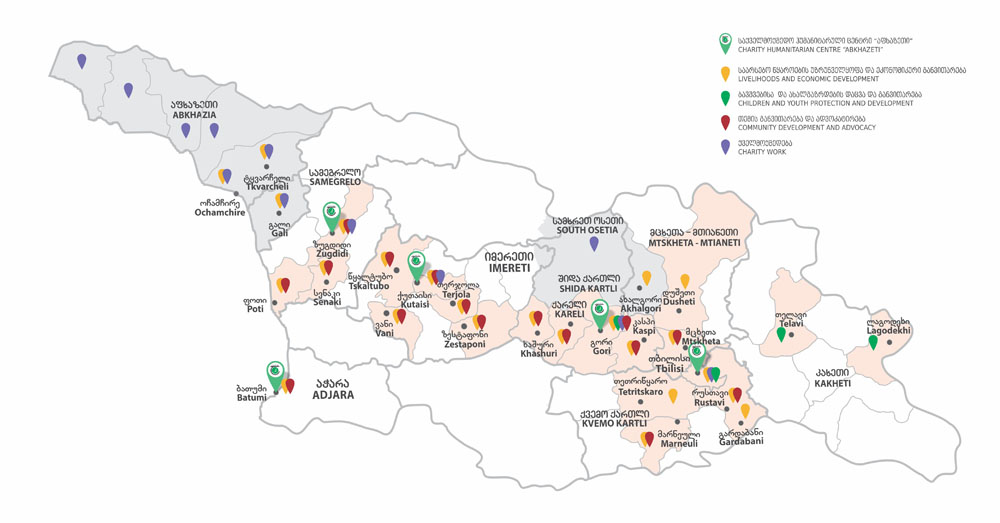
Where We Work